Wednesday, 16 May 2012

Smart Meter Privacy

John Udel has raised Smart Meters up the conciousness ladder in a timely post.
Smart meters are new. But we can’t afford to think that every new technology rewrites all the rules, requiring new legislation which, as we know, can never keep pace with innovation. Here’s a powerful simplifying rule: It’s your data. That’s the default. And you shouldn’t need to be a do-it-yourselfer to assert ownership. Even if you use a utility-supplied meter, as most people will, it’s still your data.
It's your data??? I am not sure that it is so simple. It is 'their' accounting record. The meter certainly reveals something about the occupier, which is not necessarily the other party to the power company contract, and there are certainly undesirable uses for the information - for example knowing that the house has a pattern of occupation.
There needs to be an auditable protocol for dealing with the handling of the broad swathe of surveillance data from smart power meters to smart parking and cctv but I don't think it starts with "It's my data"!
I am looking forward to the views of the NZ Privacy Commisioner on this. I would hope that some clear direction is given so that surveillance data which can be associated with individuals is treated in the same way as Personal Information and therefore covered by the privacy principles. Attaching some teeth to the principles would be good too, but one step at a time.

Monday, 26 March 2012

ICT Benchmarking NZ

The Administrative & Support Services Benchmarking Report for the Financial Year 2010/11 is probably not going to make it into the best seller list and if you have to download it from the treasury web site you may experience for yourself what the prime minister  was describing when he was quoted as “shocked” by the state of many government IT systems, which he says will need to be upgraded to improve public sector efficiency.
However, it is hard to see whether we should be appalled , content, or apathetic about the current spend of $980 million on ICT which represents nearly 57% of total government administration and support services costs.
We might expect a benchmark report to indicate some standard to be achieved but I searched in vain. $980m seems low when compared with the total expenditure of the NZ Government. The NZ Govt Treasury Web Site was down as I wrote this so I am relying on the 2011 budget forecast figure of $78,944.4 million. Actual spend was 70,450 million. So the ICT spend is about 1.3% of total spend. You can compare that with the profligate Brits who reported that the “average for the percentage of total revenue expenditure spent on ICT in central government departments is at least 5%”. They were not very happy about that but did note in a report of Public Administration Select Committee that “It is widely accepted that 3% is a benchmark of good practice in the private sector service industries for ICT spend as a percentage of total revenue expenditure. Socitm benchmarking in recent years has demonstrated that local government organisations spend consistently less than 3%”. The US federal govt spends about 2% of its 3.8 trillion expenditure on ICT.
So in benchmark terms are we spending too much or too little?
The emphasis on ICT being 57% of total government administration and support raises the same question. With pressure to cut public service numbers (the other main component of administration and support) we should be looking at increasing the proportion of the A&S cost that is taken up by ICT. But really is it a sensible benchmark factor?


Added actual NZ govt expenditure 9:24pm

Thursday, 12 May 2011

Simulation not in the BPMS please

The efforts of BPMS vendors to deliver simulation of processes have not been impressive ... even the best is more like a visualisation of the assumptions made in the process design rather than a model  that can usefully explore the real world factors that may influence future process design.
Bruce Silver has been able to consider this from the perspective of the process designer and concludes , among other things, that "Simulation should not be embedded in a BPMS". 
I agree and have argued before that the simulation should be handled by a dedicated simulation tool (after all these have been around longer than BPMS). see this post.
Fortunately we now have a formalised model of the business process in BPMN 2 that can be transformed into elements useful for a simulation engine. Similarly, the control blocks and flows that characterise a simulation model could be transformed into the starting point of a BPMN. The relationship between the simulation and the process model is 2-way.
Choose your BPMS toolset on its ability to delivery process design and implementation. Choose your simulation tool for its ability to support the analysis of the real world process under investigation.
Although I sympathise with Bruce's view that "Simulation should not require programming",  there will be occasions when the complexity and value of the model will merit more effort and experience. I suggest that the ideal simulation tool should have full logic development capability (programming) in addition to a simple wiring diagram approach.

Monday, 4 April 2011

User Interface to BPM

In Tips for the Business Process Developer - Human Interfaces to Business Processes, John Reynolds points out where the real work is in delivering a managed business process.... getting the appropriate attention of real people. Making it harder are the BPM suite providers who, in an attempt to grab the lion's share of the market claim to be providing a complete solution with hastily nailed on use transactions that take no account of how real people work - only what is needed by the BPM engine to get to its next bit of well-defined (read as simple) execution. What is needed is a well-defined interface - and John identifies the important stuff. For example ...
"To Do List" interfaces have three goals:
  • Make sure the participant knows what tasks they are responsible for
  • Make sure the participant knows when each task is due
  • Help the participant prioritize which task to work on next
That last bullet is (of course) the hard one to implement. ...
One trouble is that the implementation keeps getting left to the BPM guys. Equally bad is the suggestion that everything the important people in the business have to do is some mysterious "knowledge work" and knowing where you are in the production of business value is trivia. The big snags for everyone in the BPM implementation are

  • not everything, that people have to do, is controlled by the documented and managed business processes.
  • real people have different ways of visualising their 'to-dos' and delivering a one-size fits all mechanism is likely to be counter-productive
If we are to reduce the implementation cost of BPM we need a formal interface defined at the UI boundary and look at how the vast number of personal productivity tools can be used to but a familiar face to the interface. There are probably as many people who would react favorably to IM and Twitter-like presentation as those happy to log on a refresh a screen of activities awaiting action.

Tuesday, 8 March 2011

More on standards for presentation layer

Encouraged by the steps that have been made with SVG, I turned for another look at XFORMS, a specification that I thought had some promise a few years back. Sadly, native browser support has not miraculously appeared and requiring browser plugins or extensions is not going to sit well with corporate IT.
With the increasing power available in the browser engine, javascript solutions are now practical. XSLTForms is a great piece of work and provides cross-browser support through the standard XSL transform approach.
So, for fans of declarative language solutions,  the next challenge is to mix SVG with XFORMS. The wiki here shows a starting point but your milage may differ when you try this. My effort is here and shows some limitation in the size of image in chrome and firefox 4.
The simplistic view is that we should be able to bind the attributes/properties that describe the graphic elements in SVG to instance data in the XFORMS representation.
Starting with a simple svg element:
 <circle r="50" cx="100" cy="100" fill="grey"/>
We could manipulate the colour by including the SVG as instance data :
<xf:model> <xf:instance id="inlinesvg" src="svg/simple.svg" /> </xf:model>

and then referencing the fill parameter in an XFORMS element:
<xf:input id="myInput" ref="//svg:circle@fill"/>


I am glad to see that this actually works for me in Chrome and IE8! Cross-browser SVG is relatively new in XSLTForms so there are some wrinkles to be ironed out. I suspect that there are improvements that could be made to my simple example here as the last serious coding I did was in Fortran 4.

Monday, 31 January 2011

SVG coming back, or getting there?


I am a fan of standards as a means of presenting information and having the wide audience seeing the same thing. I was encouraged by Kurt Cagle’s post  that “SVG has made it's way to the web” but I am not sure we are quite there. Of course, SVG has been used to present graphics on the web  for some time but seeing the results has required some  fancy footwork of plugins and careful selection of browser. I think Kurt is being a little premature in his announcement that “every single major browser on the desktop” will render  even specific examples of SVG consistently.
I actually wondered what Kurt was talking about as I viewed his post in the stable Firefox 3.6.10 because the SVG was not rendered at all, but I was sufficiently interested to switch on my laptop with its standard Chrome browser.
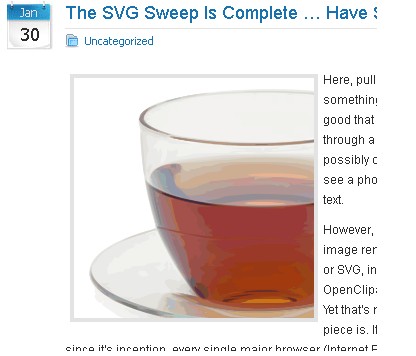
Kurt used this artwork http://www.openclipart.org/people/jhnri4/Glass_cup_with_saucer.svg demonstrating one problem with using SVG as a standard graphic ..., I can’t include this image in my Google Doc directly. But a bit of cutting and pasting gets us this.

Kurt provides it scaled to a 240 pixel square in the blog and on my FireFox 4 display it looked like this …

On Chrome however the picture is scaled differently to give you a whole cup.


The SVG word art  example in Kurt's blog was less successful, only appearing in Chrome. The scripting to change the word art did not work in Chrome or Firefox.
All this suggests that we have a way to go with our standards rendering.

[UPDATE : Came back to this later in the day and found that the word art scripting worked in FF4 and Chrome but that the wordart itself only rendered in Chrome]

Wednesday, 17 November 2010

How should EA be funded?

Alex Cullen of Forrester poses the question and provides the usual expert answer which can be paraphrased as "it depends".
The neat accounting view that there is an ongoing programme of delivery from which subventions can be drawn to pay for necessary evils of CIO, strategic planning in a manner similar to large plant replacement misses the point that you would not need active enterprise architecture people if everything was planned out.
Rather than comparing EA with IT management overheads like the CIO office, "research and development" within the wider enterprise may bear more fruit. In non-productive organisations like government agencies, policy development would be  equivalent to R&D. Then the thinking around EA funding would be closely aligned to the enterprise strategy rather than the current IT problem set. Of course, if you don't do R&D in some way then there is a pretty clear message that you are not interested in strategies so why do EA?
Practically though, if you believe that EA has a benefit for the organisation, you get the money from wherever is feeling the most pain from the lack of whatever EA will deliver.