Monday, 31 January 2011

SVG coming back, or getting there?


I am a fan of standards as a means of presenting information and having the wide audience seeing the same thing. I was encouraged by Kurt Cagle’s post  that “SVG has made it's way to the web” but I am not sure we are quite there. Of course, SVG has been used to present graphics on the web  for some time but seeing the results has required some  fancy footwork of plugins and careful selection of browser. I think Kurt is being a little premature in his announcement that “every single major browser on the desktop” will render  even specific examples of SVG consistently.
I actually wondered what Kurt was talking about as I viewed his post in the stable Firefox 3.6.10 because the SVG was not rendered at all, but I was sufficiently interested to switch on my laptop with its standard Chrome browser.
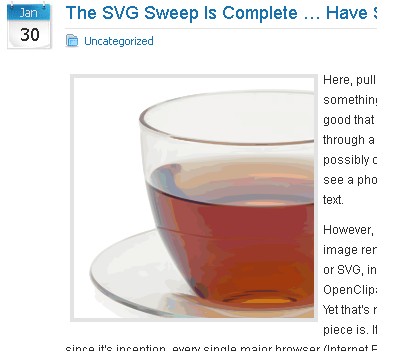
Kurt used this artwork http://www.openclipart.org/people/jhnri4/Glass_cup_with_saucer.svg demonstrating one problem with using SVG as a standard graphic ..., I can’t include this image in my Google Doc directly. But a bit of cutting and pasting gets us this.

Kurt provides it scaled to a 240 pixel square in the blog and on my FireFox 4 display it looked like this …
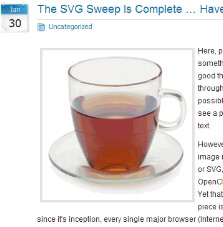
On Chrome however the picture is scaled differently to give you a whole cup.

The SVG word art  example in Kurt's blog was less successful, only appearing in Chrome. The scripting to change the word art did not work in Chrome or Firefox.
All this suggests that we have a way to go with our standards rendering.

[UPDATE : Came back to this later in the day and found that the word art scripting worked in FF4 and Chrome but that the wordart itself only rendered in Chrome]

Wednesday, 17 November 2010

How should EA be funded?

Alex Cullen of Forrester poses the question and provides the usual expert answer which can be paraphrased as "it depends".
The neat accounting view that there is an ongoing programme of delivery from which subventions can be drawn to pay for necessary evils of CIO, strategic planning in a manner similar to large plant replacement misses the point that you would not need active enterprise architecture people if everything was planned out.
Rather than comparing EA with IT management overheads like the CIO office, "research and development" within the wider enterprise may bear more fruit. In non-productive organisations like government agencies, policy development would be  equivalent to R&D. Then the thinking around EA funding would be closely aligned to the enterprise strategy rather than the current IT problem set. Of course, if you don't do R&D in some way then there is a pretty clear message that you are not interested in strategies so why do EA?
Practically though, if you believe that EA has a benefit for the organisation, you get the money from wherever is feeling the most pain from the lack of whatever EA will deliver.


Monday, 8 November 2010

Google apps are different if you speak American

In a departure from the data management good practice that I learned a while back, Google use the language setting for US English (rather than the proper one :) to determine how there apps work rather than simply the words , spelling, and punctuation used.
I discovered this as I set up a new apps account , accidentally left the default setting for language as US and discovered that I could use Google Voice to dial out to US and Canada for free from New Zealand. Not a big saving over Skype but a demonstration of how things are coming together in a common look and feel and set of services 'in the cloud'. Now your Google contact list is a one stop shop for outbound calling. Of course, there are ways of running a full Google Voice service outside the US but that requires a little more effort than putting up with a few odd spellings :)
The Google Apps dashboard also functions differently with US setting.

I am still a bit concerned that the gung-ho people from Google should misuse the language attribute rather than define a specific setting "Google-Voice-On". What next , identifying Europe by the use of the currency euro? Close enough?

Monday, 25 October 2010

Bob the hero?

Bob (Google Apps Script wizard) the hero?

Is Bob the hero of the company or has his boss and IT governance allowed him to become the biggest risk.
Google Apps scripts were showcased in a strong presentation at Google I/O 2010. In it, "Bob" was portrayed as a hero for great business performance improvement using spreadsheets and scripts. Although the scripting features presented form a sound toolkit for development around the Google Apps, I am concerned that they may simply replicate earlier problems in IT development.
I have reviewed government and commercial organisations and found much of their operations were centred on spreadsheets or MS Access databases and the like that had grown up from a long departed staffer's need to produce a one-off report for the manager. Auditability and indeed what a spreadsheet was intended to calculate had been lost in the mists of time. Do it yourself Business Process Automation as presented by the Google Apps team seems to offer the same opportunity for foul up but with the potential for more far reaching effects.
The example from Motorola in the second part of the presentation was impressive for its achievement of savings and business process improvement but rather had the hallmarks of an IT shop rather than a "Bob". Even with an IT project approach, there needs to be some consideration to the governance issues presented by such adhoc Business Process Automation. This concern was echoed in a question at the end of the video but not answered.
How do we avoid losing sight of key corporate information spread over contact lists, third party solutions and spreadsheets in the cloud?
Alternatively how do we empower the "Bobs" without hampering them with portfolio management, programme directors, project managers, advisory boards and other manifestation of "good" governance?

Wednesday, 13 October 2010

Should Government Mandate Backdoors f...


Despite the US being one bit of the world it seems to regard the Internet as its own rather than a global system of interconnected computer networks that use the standard Internet Protocol Suite to serve billions of users worldwide.
So now the FBI wants to snoop on any internet traffic it chooses.
What about the rest us whose traffic may accidentally pass through US controlled space? Do we, or our governments, get a say?
Apart from it being a bad idea technically to introduce backdoors because they offer a tempting target for the bad guys, misuse of the information gained by surveillance of the kind proposed is common. Governance of backdoor snooping is non-existent on the worldwide scale.

Friday, 8 October 2010

Government Enterprise Architecture - ...


Nick Malik identified some challenges in Federal Enterprise Architecture in a recent post. Which lead me to question how hard can it be to use Enterprise Architecture practices to support more effective government?

Considering the business of government rather than concentrating on the nuts and bolts of IT in the abstract, there are very few patterns of government business. Even those of us protected(?) by the 'Westminster System of Goverment' can eventually map out the nature of business.

Much of the business of ministries, departments of state, and even minor agencies is not peculiar to their title or function. Formulating policy; measuring impact of policy; funding; communicating with citizens are a major part of every arm of government and there is value in having a common set of 'all of government' functions, activities, business rules etc. At the very least, it would reduce the number of reinventions of the wheel taking place in the areas of process improvement and consequential ICT solutions.

The remainder of the departmental business can be further divided. Sectors of government are often handled by a number of separate agencies (Education, Transport, Justice for example spawn agencies dedicated to special functions,like standards in education). There are however common objects, and objectives across the sectors (eg students; roads; people). This leaves a small amount of the business of a single government department that is peculiar to that small enterprise. 

There is, of course, a reasonable amount of Enterprise (IT) Architecture going on a whole of government basis driven by cost pressure but the scope for improving the whole operation of government is vast. Despite the advantage that government, as an enterprise, has over commercial enterprises, I do not see much evidence of the full scope of Enterprise Architecture in government. The size of the architecture problem would be considerably smaller and more likely to be delivered upon if the common elements were dealt top-down ...
 One view of the all-of-government; one view for each sector of government for the bits that remain; and then one view for each organisation for the bits that are truly the unique interest of that department.

Thursday, 30 September 2010

Dynamic BPM Success Story

Sandy Kemsley brought us some good news here with
  • a government department going from legislation to operation system in 12 months;
  • agile methods in a government program of work;
  • (dynamic) BPM underlying case management
What a pity the growth 'industry' is the UK's Insolvency Service.